Multiband saturationFounders’ price until 30 November
RSL Dual Core Saturator Two cores. One decision.
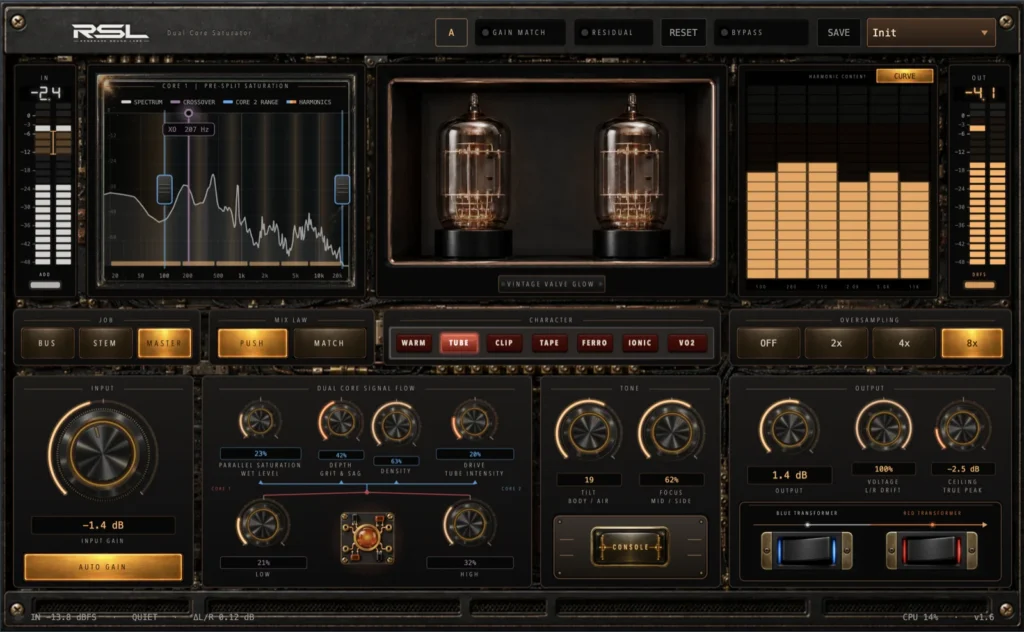
Split the signal at a crossover you choose and drive each band through its own saturation core: seven characters, gain match so you judge tone rather than level, and a residual monitor to hear exactly what is added.
AU, VST3, AAX and Standalone on macOS 11 or later; VST3 and Standalone on Windows 10 or later (64-bit). Activates through RSL Hub on up to 4 computers. Also included in RSL All Access.
Producers on RSL Dual Core Saturator
What they say about it
This plugin is crazy! It gets everything I want loud, and in the best way.
On the RSL Dual Core Saturator
 Dawgs DabatoMusic Producer / Engineer20+ yrs industry experienceCredits include
Interscope | AMC/ALL BLK
The RSL Dual Core Saturator has completely transformed my workflow. Standard saturators usually force a compromise between warmth and clarity, but this plugin makes tracks hit significantly harder while keeping them bigger, fuller, and completely transparent.Having precise control over two distinct saturation cores is an absolute game-changer. You get that extra punch and energy without muddying up the low end or killing your mix’s natural dynamics and audio quality. It has instantly become my go-to saturator—it’s earned a permanent spot on my mixing chain for every single project.
On the RSL Dual Core Saturator
 Oz Vega@oz_prod_it
The RudeboyFinesse albums RUDESUMMER and STILLSUMMER were mastered with this plugin. Stream them, then judge the demos below.
AAX on macOS
Now in Pro Tools
The macOS installer includes an AAX build, so Pro Tools loads the RSL Dual Core Saturator like any other plugin.
- Where
- Pro Tools on macOS 11 or newer, from version 1.9.0. AAX sits alongside the Audio Unit, VST3 and Standalone builds
- Installing
- Leave AAX (Pro Tools) selected in the installer, then restart Pro Tools so it finds the plugin
- Already own it
- Update it in RSL Hub, or download the macOS installer again from your account and run it; the update is free. Bought before 4 October? Your license key keeps working, and the AAX version is in the same download
- AudioSuite
- Not included, on purpose. Ferro, Ionic and Tape warm up over several seconds, so an offline render of a short selection would not match what the same settings do while playing
- Windows
- The Windows download does not include AAX yet
Made for
Who it is for
Producers
Weight and forward motion on individual tracks, without reaching for the fader.
Mix engineers
Cohesion across a bus, with the low end protected from the drive that glues the top.
Mastering engineers
Density on the full mix with true-peak control and up to 8x oversampling before you commit.
The idea
What it does
It adds harmonic content to a signal and lets you decide exactly where that content lands.
A mix that feels thin rarely needs more level. It needs density: extra harmonics that give the ear something to hold onto, so a part reads as present without climbing over everything else. That is what saturation is for, and it is the reason a track can measure correctly and still sound unfinished.
The catch with most saturation is that the low end takes the hit first. Bass carries the energy, so it reaches the nonlinear part of the circuit before anything else and dominates the result. Push hard enough to hear the top change and the kick has already smeared.
Signal flow
How it works
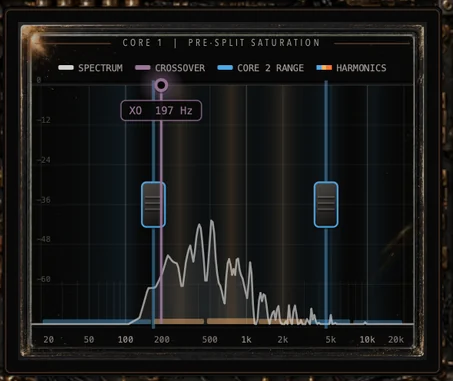
One crossover, two saturation cores, recombined through a shared output stage.
1. You place the split
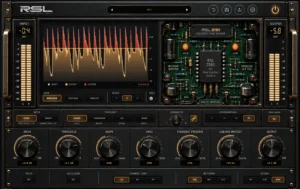
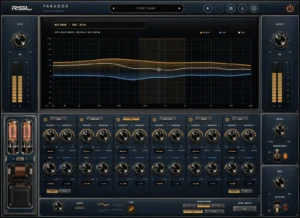
The crossover sets the frequency where the signal divides. Everything below it goes to one core, everything above it to the other. The analyzer shows the split point and both core ranges, so you are placing it by ear and by eye rather than guessing.
2. Each band gets its own core
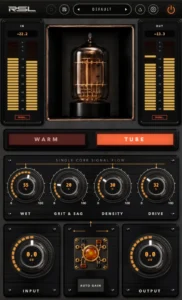
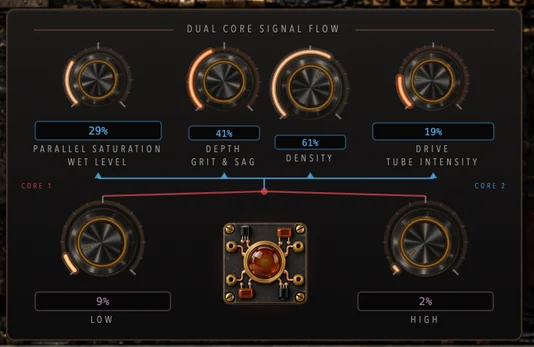
The two cores are driven separately, with their own amounts for the low and high bands. Keep the bottom composed while the top is pushed hard, or invert it when the record wants weight underneath and clarity above. Wet level, Depth, Density and Drive shape what each core is doing.
3. They recombine through one output stage
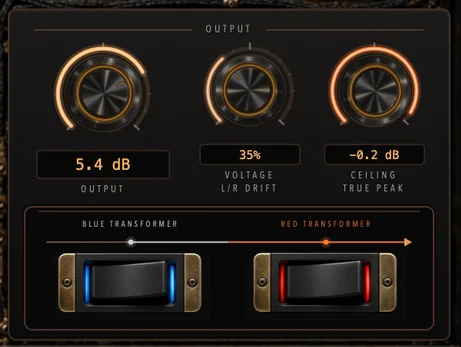
Both bands pass through a shared console output stage, which is what stops band-split processing from sounding like two unrelated plugins bolted together. Transformer voicing, voltage drift and a true-peak ceiling finish the signal.
Features
Everything in the plugin


Saturation
- Seven characters: Warm, Tube, Clip, Tape, Ferro, Ionic, VO2
- Two independently driven cores
- Tunable crossover between them
- Parallel saturation wet level
- Depth (grit and sag)
- Density
- Drive (tube intensity)
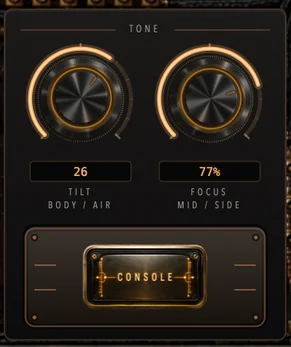
Tone
- Tilt, body against air
- Focus, mid against side
- Console treatment
Output
- Blue and Red transformer voicings
- Voltage L/R drift
- Ceiling with true-peak limiting
- Output gain
Workflow
- Job modes for Bus, Stem and Master
- Push and Match mix laws
- Oversampling: off, 2x, 4x, 8x
- Gain match
- Bypass
Metering
- Spectrum analyzer with crossover overlay
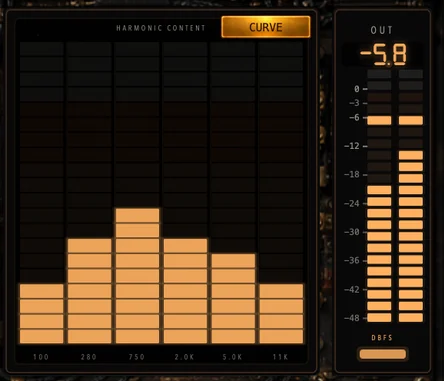
- Harmonic content display
- RTA harmonic injection
- Residual monitoring
- Peak dBFS input and output meters
How to get it
Own it, or get every plugin
Own it
RSL Dual Core Saturator
$69once
Founders’ price, then $99. Yours to keep, with its updates.RSL All Access
This plus 5 more
$15/ mo, billed yearly
Every RSL plugin and every new one, with every update. No card for the trial. Or $18 monthly.RSL Complete
All 6, yours to keep
$349once
Founders’ price, then $449. Every current plugin; new ones are not included.Specs
Compatibility and licensing
- Operating system
- macOS 11 or newer, or Windows 10 64-bit or newer including Windows 11
- Processors
- macOS: Universal 2, native on Intel and Apple Silicon. Windows: 64-bit Intel or AMD
- Plugin formats
- macOS: Audio Unit, VST3, AAX and Standalone. Windows: VST3 and Standalone
- DAW compatibility
- Any 64-bit host that loads AU or VST3, including Logic Pro, Ableton Live, FL Studio, Reaper, Studio One, Bitwig and Cubase, plus Pro Tools on macOS. Mono or stereo
- Not supported
- AAX on Windows, so Pro Tools on Windows will not load it yet. No VST2, no Audio Unit on Windows, and no native Windows-on-ARM build
- Display
- Fixed 1040 × 680 editor window, comfortable at 1920 × 1080 or HiDPI
- Activation
- Through RSL Hub with your Renegade Sound Labs account, up to 4 computers. License keys bought before 4 October 2026 keep working, up to 3 devices
- Current build
- Retail release: v1.9.5 on macOS and Windows
Questions
Questions before you buy
Will it run on my machine?
On macOS it needs 11 or newer, and the build is Universal 2 so it runs natively on Intel and Apple Silicon with no Rosetta translation. On Windows it needs 10 64-bit or newer, including Windows 11, on a 64-bit Intel or AMD machine. There is no native Windows-on-ARM build, and there is nothing else to install: no Visual C++ redistributable is needed.
Which formats do I get?
On macOS, Audio Unit, VST3, AAX for Pro Tools and a Standalone application. On Windows, VST3 and a Standalone application. There is no VST2 build, and Audio Unit is a macOS format only. One purchase covers both platforms.
Does it work in Pro Tools?
Yes, on macOS. The macOS installer includes AAX alongside Audio Unit, VST3 and Standalone, so Pro Tools loads it. The Windows download does not include AAX yet.
Windows says the publisher is not recognized. Is that safe?
Yes, and it is expected. The Windows installer is not code signed yet, so Microsoft Defender SmartScreen warns you the first time you run it. Choose More info, then Run anyway. Code signing is on the way. The macOS build is unaffected.
How many computers can I use it on?
Up to 4, through RSL Hub, our free app: free one up in RSL Hub or under Activated computers on your account page. License keys bought before 4 October 2026 keep their 3-computer limit.
What happens after I buy?
Open RSL Hub, sign in with your Renegade Sound Labs account and choose Install. It activates by itself, with no key to type, and RSL Hub renews the activation in the background. The installers are also kept under Downloads in your account.
I already have a license key. Does it still work?
Yes. License keys keep working. From version 1.9.2 you can also activate by signing in to RSL Hub with your Renegade Sound Labs account, instead of typing the key.
Is this the finished plugin or a beta?
It is the finished retail release, on macOS and Windows. It activates through RSL Hub when you sign in with your account.
What happens to the price after the offer ends?
It returns to $99. Buying at the founders' price is a one-time payment, not a subscription.
Is it included in RSL All Access?
Yes. RSL All Access is every RSL plugin, this one included, for $18 a month or $180 a year, with a 14-day free trial and no card needed. Cancel any time. Plugins you buy stay yours.
Pairs with
Works well alongside it
RSL Dual Core Saturator
Two cores. One decision.
Founders' price: $69 through 30 November, then $99
- Secure checkout
- Instant access in RSL Hub
- Up to 4 computers