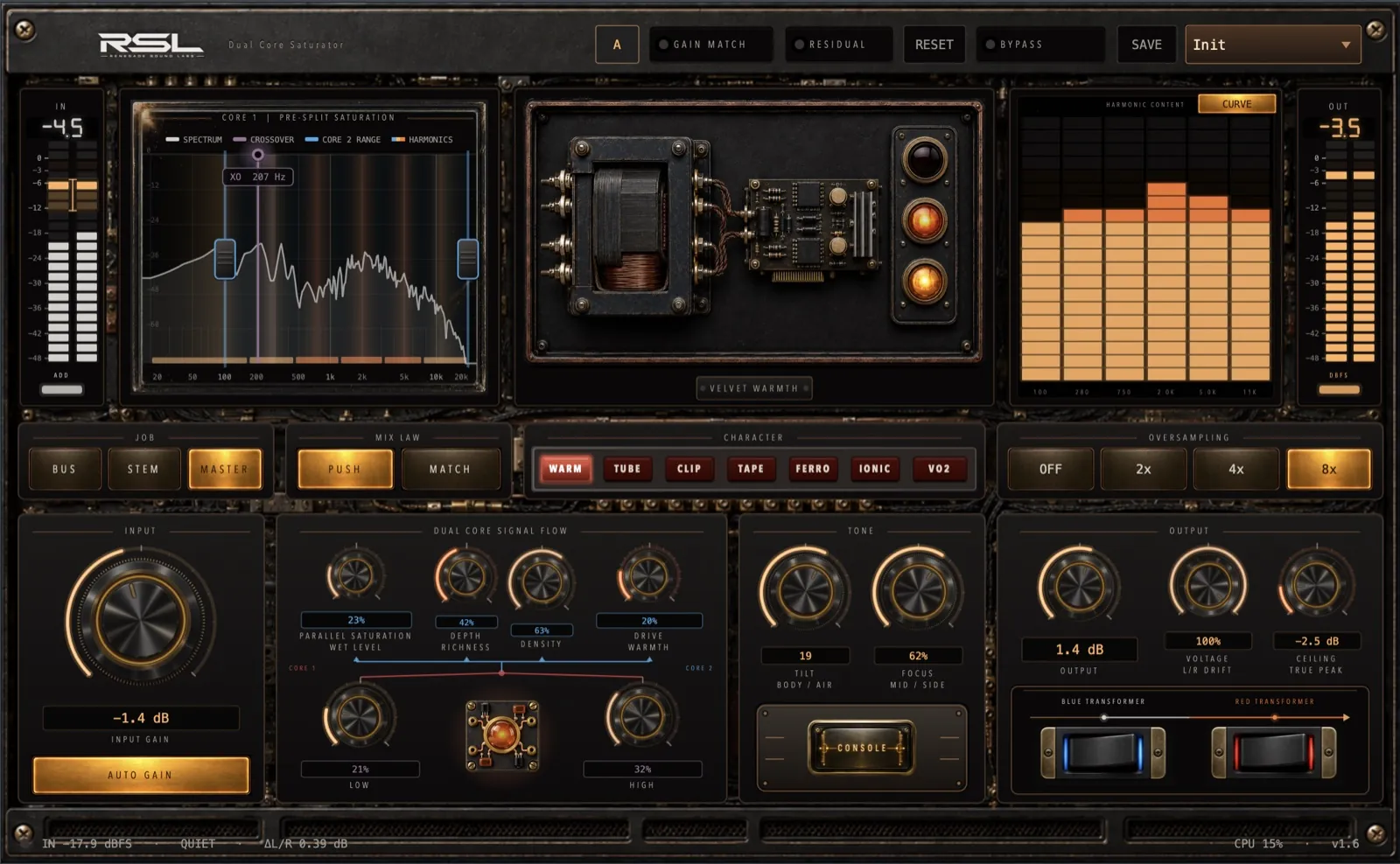
Put one saturator across a full mix and the loudest band decides what everyone else gets: the kick smears before the top end gets exciting. This plugin splits the signal where you choose and drives each side on its own core. What follows is the whole circuit, in the order the audio meets it.
2saturation cores
7modeled characters
8×oversampling
−3 dBtrue-peak ceiling
01 The signal path
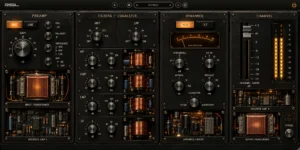
Ten stages, in the order the audio meets them
The short version: two saturation cores do the work, and everything after them is the output stage that carries the result out of the plugin.
Swipe the chain sideways
The marked stages run oversampled, up to 8×, which is where aliasing would otherwise be made. Everything after the transformers runs at the session rate.
Core 1, before the split
A restrained Warm stage that divides the spectrum at a single crossover and lets the low and high regions take independent amounts of pre-saturation. It prepares the material before anything parallel happens.
Core 2, the parallel engine
Mid/side band isolation, the selected character, residual extraction, then Density, Wet, Tilt and Focus. Two blue handles set the band it works on, and content outside that range is excluded rather than attenuated.
02 The residual
It adds the difference, not the distortion
The part that is easy to miss: Core 2 never replaces your band. It isolates one, processes it, subtracts the original, and blends only what is left.
Step 1 · Isolate
The band between the two handles, taken out of the mid and side signal on its own.
Step 2 · Process
The character works on that band alone. The original shape is still there underneath it.
Step 3 · Subtract and blend
Subtract the original band and this is what is left: the new harmonic and level-moving content, and nothing else. Wet sets how much of it joins the dry signal.
That is why density can go up while the original transient path stays intact, and it is why a mix takes a lot of this before it starts sounding processed. You are hearing your own signal with something added underneath it rather than a copy of it that has been redrawn.
Mix law: what happens to the dry path as you raise Wet
Mix law
Dry path
Core 2 residual
Push
Remains at unity.
Layers on top as Wet rises.
Match
Fades as the processed contribution rises.
Crossfades toward the processed result.
03 Seven characters
What each one is actually modeling
Drive sets the musical operating amount. Depth changes how far the model is allowed to travel, so its meaning changes with the character. On three of them, passing a threshold opens behavior that was not there at lower settings.
01
Symmetric, odd-weighted
Warm
The one to reach for when you want cohesion rather than an effect anyone can name.
A smooth, symmetric saturating response weighted toward odd harmonics. Depth adds richness without turning the stage into a hard clipper, which is why the same circuit sits under everything else as the pre-split stage.
Drive
Warmth and glow
Depth
Harmonic richness
Best for
Bus glue, vocals, broad cohesion
02
Asymmetric valve
Tube
Even-order color that gets less clinical the harder you push it.
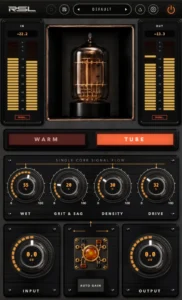
An asymmetric valve response with additional even-order character. As Depth rises the circuit develops stronger asymmetry, vintage sag and progressive high-frequency softening, the way a valve stage does when it is asked to work.
Drive
Tube intensity
Depth
Grit, sag and softened top
Best for
Vocals, bass, drums and buses that should feel less clinical
03
Rounded to hard
Clip
Drive walks the signal up to the edge. Depth decides how firm that edge is.
A continuously variable rounded-to-hard clipping stage. The true-peak Ceiling is a separate stage further down the chain, so shaping the transient and protecting the output never have to fight each other.
Models stateful oxide magnetization, restrained hysteresis, a head bump, program-dependent compression, level-dependent treble loss and subtle wow and flutter. 30 IPS emphasizes the classic warm low-end head bump; 60 IPS moves that emphasis up toward the low mids.
Drive
Magnetization amount
Depth
Opens the soft ceiling
Best for
Density and glue with movement
Tape opens in tiers
DensityDrive 0 to 100%Low-level thickening and mild even harmonics.
MagnetDrive around 40%Hysteresis, head bump and greater harmonic density.
LimitDepth around 18%Soft ceiling, program compression and HF saturation.
05
Living ferrofluid core
Ferro
Sustained sound changes what the next transient runs into.
Ferro carries magnetic memory. It tracks per-core magnetization, a shared field, thermal conditioning and polarity lean, and mid/side activity can influence the shared chamber. It is not a curve. It is a system with a history.
Drive
Iron density
Depth
Opens bloom, then chaos
Best for
Weight with movement, low-mid character
Ferro opens in tiers
IronDrive 0 to 100%Low-mid density and transformer weight.
BloomDrive around 60%Harmonic bloom, softened transients, dynamic HF rounding.
ChaosDepth around 20%Intermodulation, transient-dependent compression, drifting phase.
06
Liquid gain cell
Ionic
Not a waveform shaper. It moves level, then blends the difference.
Below its reference region Ionic can lift; above it, it restrains. Mid and side share one virtual ion cloud, which protects image stability, and transients can pass before the slower cell completes its reaction. Its harmonic display therefore shows level movement rather than new harmonic orders.
Drive
Primary leveling action
Depth
Viscous memory, longer hold, swelling recovery
Best for
Density and control without obvious distortion
07
Phase-transition distortion
VO2
A wafer that stays partly metallic after the energy that triggered it has gone.
Models a vanadium-dioxide wafer transitioning from insulating sapphire to metallic domains. The transition is abrupt and hysteretic. This is the one to reach for when the record wants something that sounds broken on purpose, and the first one to back off when it does not.
Drive
Approach to the threshold
Depth
Opens instability
Best for
Aggressive color and deliberate instability
VO2 opens in tiers
ColdDrive 0 to 100%Crystalline grit approaching the phase threshold.
MetalDrive around 80%Abrupt clip and octave-up components.
ChaosDepth around 13%Sputtering, period-doubled subharmonics, instability.
Tape and Ferro are stateful. Played from the same spot twice they will not produce exactly the same response, because recent program history is part of the sound.
04 The meters
Instruments, not decoration
Two of the readouts are measurements you can act on rather than animation: where your input sits, and how much the character is actually adding.
Core 2 reaches full scaling between −12 and −6 dBFS, opens progressively below it, and deliberately backs off above it. Set the input by eye and the readout tells you which side of the window you are on.
Injection heat is measured
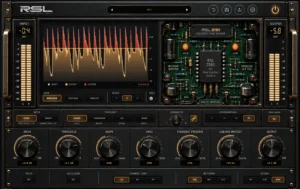
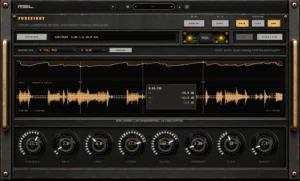
The color on the analyzer is measured residual energy from the active character, not an estimate from knob positions. Blue is light, gold is moderate, orange is strong. The six-band harmonic meter then shows how those regions move over time.
Residual solo and gain match
Residual solo isolates the Core 2 difference signal on its own, with the output transformers and Console deliberately excluded, so what you hear is the dual-core contribution and nothing downstream of it. Gain match then levels the comparison, which is the only way an A/B tells you anything true.
Hear it on your own material
The level-matched demos on the product page make the case in about thirty seconds. The trial makes it on your session.
No card required · 14 days, full plugin · macOS 11+ and Windows 10+
Cookies.Essential ones keep the shop working. Analytics and marketing are optional. Details.
RSL All AccessEvery RSL plugin. One subscription.All 6 plugins and every new one we make, installed through RSL Hub on up to 4 computers.$15/mo, billed $180 yearly 2 months freeStart your free trialSee plansOr $18 monthly · 14 days free, no card · Cancel anytime