EqualizerFounders’ price until 30 November
RSL Paradox Tight lows and open highs from one EQ move.
RSL Paradox boosts and attenuates at the same frequency, the classic passive EQ move, on six bands from LOW to AIR. One SHAPE control changes how every curve behaves.
AU, VST3, AAX, Standalone on macOS 11 or later; VST3, Standalone on Windows 10 or later (64-bit). Activates through RSL Hub on up to 4 computers. Also included in RSL All Access.
Made for
Who it is for
Producers
Shape bass, drums, vocals and instruments with a boost and a cut on the same band, then sweep one SHAPE knob to hear four different equalizers from the same settings.
Mix engineers
Put it on buses or the mix bus for weight against clarity, judge every move at matched level with GAIN MATCH, and work in mid / side when the low end needs to sit in the center.
Beatmakers
Use the low-end trick on kicks and 808s: weight underneath, a dip just above it, with factory starting points for sub foundation and small-speaker bite.
The idea
What it does
RSL Paradox is a six band dual curve equalizer where every band boosts and cuts at the same frequency, and the two curves work together instead of canceling.
On an ordinary equalizer a boost and a cut at the same frequency cancel out. On a classic passive equalizer they don’t: turn both up and the low end lifts underneath while a dip opens just above it, so the bottom gets tighter instead of just bigger. Engineers have leaned on that trick for decades, but only on the low and high sections of the hardware.
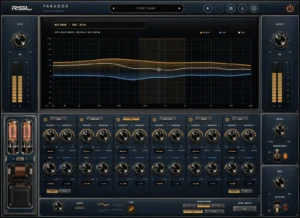
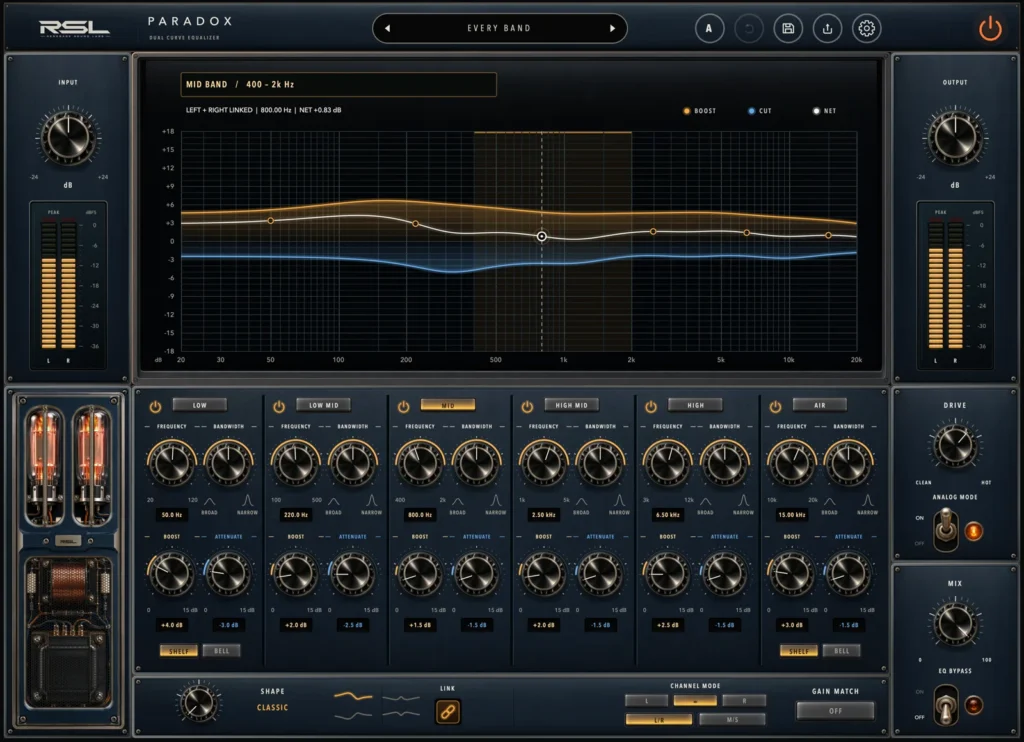
RSL Paradox gives that pair of curves to all six bands, each with its own BOOST and ATTENUATE, 0 to 15 dB. One SHAPE knob decides how the two curves sit against each other across every band at once, and a valve and transformer stage finishes the signal. The graph draws exactly what the audio is doing.
Signal flow
How it works
The signal runs from INPUT through left / right or mid / side, the six bands and SHAPE, the analog stage, MIX and GAIN MATCH, to OUTPUT.
Input and channels
INPUT sets the level going in, -24 to +24 dB, and with ANALOG MODE on it also drives the circuit. Choose left / right or mid / side processing. Linked, you edit one equalizer for both channels; unlinked, each channel has its own six bands.
Six bands and SHAPE
Each band has FREQUENCY, BANDWIDTH, BOOST and ATTENUATE, and the boost and the cut shape the band together. SHAPE then sets how every boost and cut relate: CLASSIC, FOCUS, TILT, HOLLOW or anywhere between. Your amounts stay where they are while the whole equalizer re-voices.
Analog stage, mix and output
ANALOG MODE adds an input transformer ahead of the curves and valve stages and transformers after them, with DRIVE setting how hard they are hit. MIX blends the equalized signal with the unequalized one, delay-compensated. GAIN MATCH trims the output so a boost is judged on its shape, and OUTPUT sets the final level.

Features
Everything in the plugin
SIX DUAL CURVE BANDS
- LOW, LOW MID, MID, HIGH MID, HIGH and AIR, 20 Hz to 20 kHz
- Independent BOOST and ATTENUATE on every band, 0 to 15 dB each
- FREQUENCY within each band’s range
- BANDWIDTH from BROAD to NARROW
- SHELF / BELL switch on LOW and AIR
- Band power that glides out instead of clicking
SHAPE
- One knob re-voices all six bands at once
- CLASSIC: weight against clarity
- FOCUS: a point of emphasis with its surroundings pulled back
- TILT: brighter above the frequency, leaner below
- HOLLOW: a broad lift with a notch in the middle
- Continuous between stops, so the curve never jumps
GRAPH
- Boost (amber), cut (blue) and net (white) curves
- Drag a node to set frequency, boost or cut
- Hold Shift for fine adjustment
- Double-click a node to zero its boost and cut
- Readout of the selected band and the net response in dB
ANALOG STAGE AND LEVEL
- ANALOG MODE valve and transformer stage, on by default
- DRIVE from CLEAN to HOT, changes color, not loudness
- MIX for parallel equalization, delay-compensated
- EQ BYPASS takes the curves out and leaves the analog stage in
- GAIN MATCH for level-matched comparison
- INPUT and OUTPUT, -24 to +24 dB, with peak meters and clip lamps
CHANNELS AND WORKFLOW
- Left / right or mid / side, linked or independent
- 23 factory presets, plus your own as .rgpreset files
- A / B compare of two complete settings
- Zero latency mode for tracking and playing live
- Right-click any knob to type a value
- Resizable window, 50 to 150 percent
How to get it
Own it, or get every plugin
RSL All Access
This plus 5 more
$15/ mo, billed yearly
Every RSL plugin and every new one, with every update. No card for the trial. Or $18 monthly.RSL Complete
All 6, yours to keep
$349once
Founders’ price, then $449. Every current plugin; new ones are not included.Specs
Compatibility and licensing
- Operating system
- macOS 11 or newer, or Windows 10 64-bit or newer including Windows 11
- Plugin formats
- macOS: Audio Unit, VST3, AAX and Standalone. Windows: VST3 and Standalone
- Pro Tools
- Yes, on macOS: the installer includes AAX. There is no AAX on Windows yet
- Activation
- Installed and activated through RSL Hub on up to 4 computers, with no license key
- Current build
- Version 1.0.3 on macOS and Windows
- Type
- Six band dual curve equalizer
- Boost and cut
- Independent per band, 0 to 15 dB each
- Shapes
- CLASSIC, FOCUS, TILT, HOLLOW, continuously variable between
- Channel modes
- Left / right or mid / side, linked or independent
- Channels
- Mono or stereo (mid / side needs stereo)
- Processing
- Curves and analog stage at twice the session rate
- Latency
- 46 samples at every sample rate (1.04 ms at 44.1 kHz), reported to the host; 0 with Zero latency
- Presets
- 23 factory presets; user presets as .rgpreset files
- Interface
- 1200 x 870 at 100 percent, 50 to 150 percent from the settings
Questions
Questions before you buy
Will it run on my machine?
RSL Paradox runs on macOS 11 or later, on Apple Silicon or Intel, and on 64-bit Windows 10 or later. The current build is v1.0.3 on both.
Which formats do I get?
On macOS you get AU, VST3, AAX for Pro Tools and a Standalone app. On Windows you get VST3 and a Standalone app.
Does it work in Pro Tools?
Yes, on macOS, as an AAX plugin. There is no AAX version for Windows yet.
How many computers can I use it on?
Up to 4. RSL Paradox activates through the free RSL Hub app with your Renegade Sound Labs account, so there’s no license key to keep track of.
Is there a free trial?
Yes. You can try RSL Paradox free for 14 days before you buy.
What happens to the price after the offer ends?
The founders’ price of $69 runs through 30 November, then RSL Paradox is $99. Either way it’s a one-time purchase, yours to keep with its updates. You can refund it within 14 days of purchase, for any reason.
Is it included in RSL All Access?
Yes. RSL All Access includes RSL Paradox for $15 a month billed yearly, or $18 monthly, and starts with a 14-day free trial with no card needed.
Won’t a boost and a cut at the same frequency just cancel?
Not here. On RSL Paradox they are two different curves around the same frequency, so turning both up shapes the band instead of flattening it. SHAPE decides where each one sits.
Does it add latency, and can I track through it?
It runs at twice the session rate and reports 46 samples, about a millisecond, which hosts with delay compensation correct automatically. For tracking or playing live, switch on Zero latency in the settings panel and nothing is reported to the host.
Pairs with
Works well alongside it
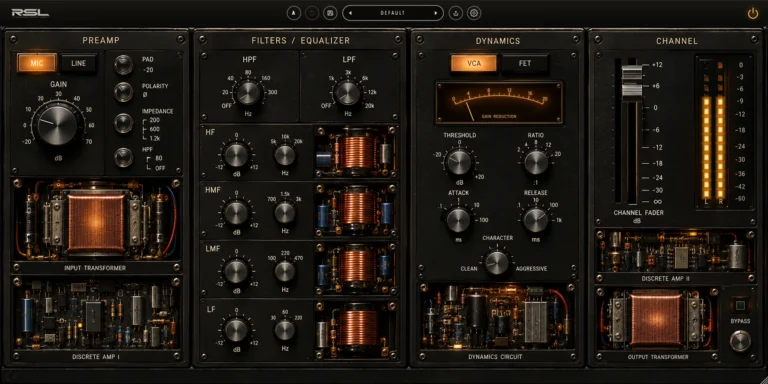
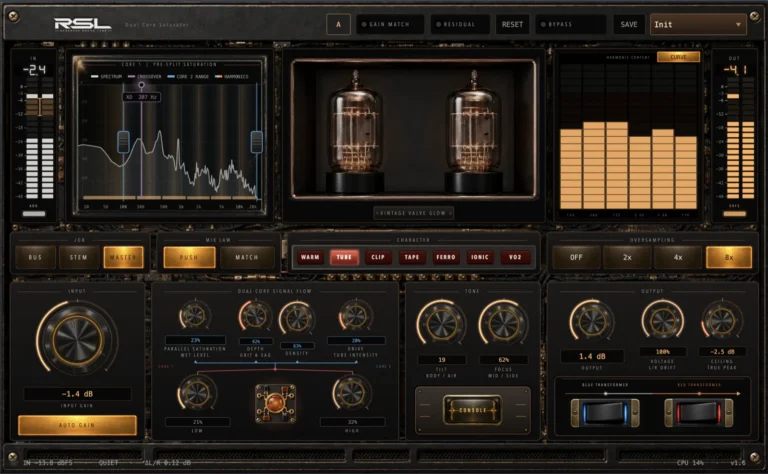 Pairs withRSL Dual Core SaturatorMultiband saturation: two cores, split at a crossover you set.$69
$99· Included in All Access
RSL Paradox
Tight lows and open highs from one EQ move.
Founders’ price: $69 through 30 November, then $99
- Secure checkout
- Instant access in RSL Hub
- Up to 4 computers