0
Subtotal

RSL Bastion Available now
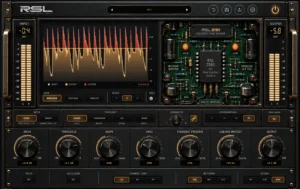
A vari-mu stage that levels program material the way a needle reads it, and a discrete VCA stage that catches the peaks it leaves behind. Run them in either order, see which one is doing the work, and hear exactly what each is taking.
$69, regular price $99. Available now.
Installed and activated through RSL Hub on up to 4 computers, with no license key to enter.
AU, VST3, AAX, Standalone on macOS 11 or later; VST3, Standalone on Windows 10 or later (64-bit)
RSL Bastion controls dynamics; it is not a color box. For harmonic density put the Dual Core Saturator in front of it, and set the compression afterwards.
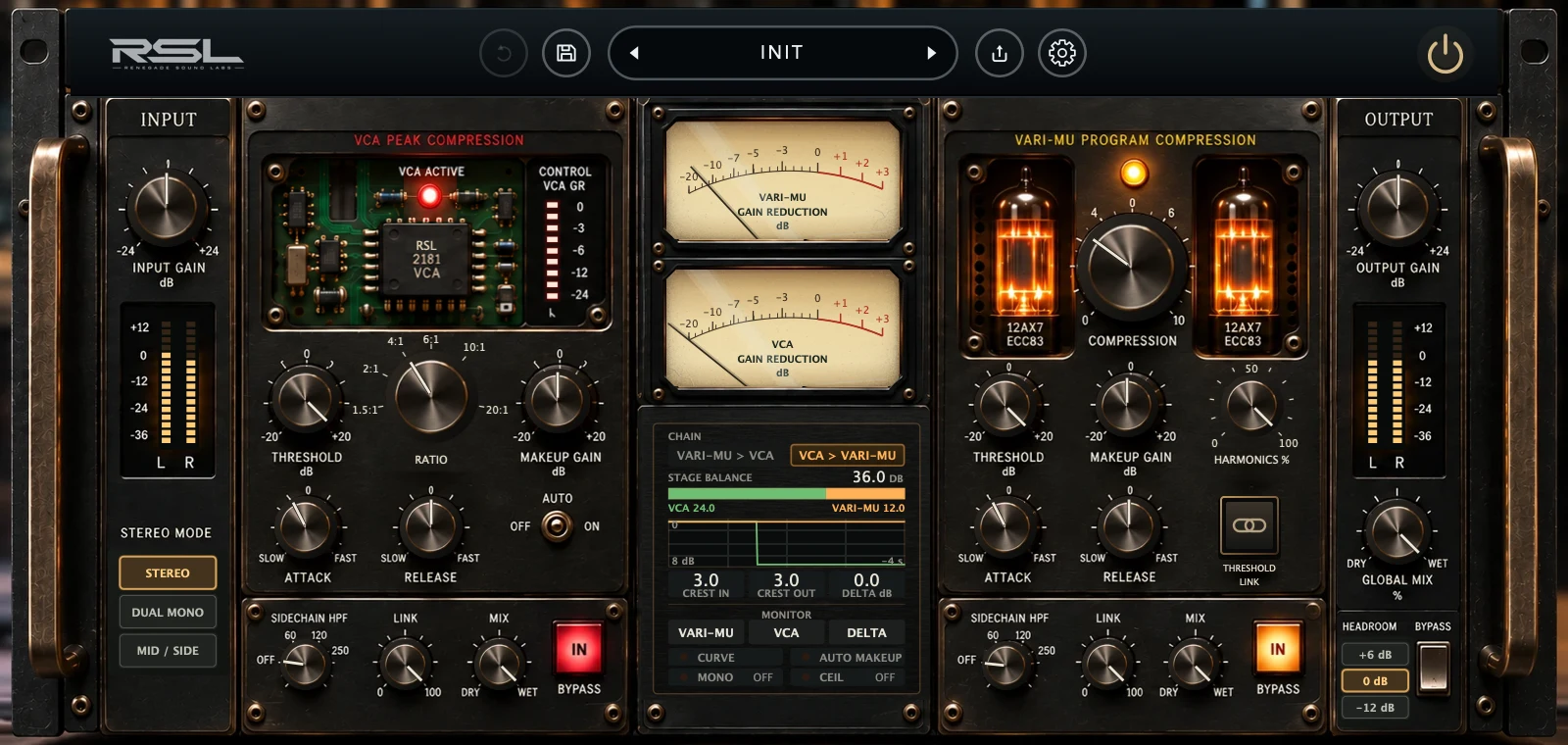
The musical stage. It reads level rather than peaks, its curve has no corner, and it never audibly grabs: the reduction settles instead of clamping. It is what makes a mix feel dense and cohesive rather than held down.
COMPRESSION is drive, not a threshold. It pushes harder into a fixed cell and takes the same amount back out, so turning it up makes the stage work harder, not louder. The tubes distort more the harder it is working, and HARMONICS decides how much of that you keep.
The precision stage. Rectifier detection, ballistics on the gain, and the ratio, knee, attack and release you chose — nothing program-dependent unless you ask for it with AUTO release. This is the stage that makes the record feel finished.
Everything is a detent. Ratio, attack, release and knee land on marked positions, so a setting you like is a setting you can write down and find again on the next song.
The order is yours: VARI-MU → VCA to level the program first and catch what escapes, or VCA → VARI-MU to take the peaks off before the tube stage ever sees them. The panel follows the order you pick, so the stage that runs first is the one on the left.
| Vari-Mu | VCA | |
|---|---|---|
| What it reads | Program level, the way a needle does | Peaks, the moment they arrive |
| How it takes hold | No corner to the curve, so it never audibly grabs | The ratio and knee you dialled, exactly |
| Its main control | COMPRESSION, which is drive into the cell, not a threshold to chase | THRESHOLD and RATIO, from 1.5:1 to 20:1 |
| Times | Attack 60 ms to 1.5 ms, release 2.5 s to 90 ms, and the release stretches when it has been working | Attack 0.1 to 30 ms, release 0.1 to 1.2 s, or AUTO |
| What it leaves behind | Density, and second and third harmonic you can dial from 0 to 100 percent | Punch, and a peak that stays where you put it |
Two stages in series are only worth more than one stage twice if they behave differently, so every choice that could go either way went the other way on the second stage. Each keeps its own sidechain high pass, its own stereo link and its own wet / dry mix, so either one can be run in parallel without the other following it.

How to get it
RSL All Access
$15/ mo, billed yearly
Every RSL plugin and every new one, with every update. No card for the trial. Or $18 monthly.RSL Complete
$349once
Founders’ price, then $449. Every current plugin; new ones are not included.
 RSL All AccessEvery RSL plugin. One subscription.All 6 plugins and every new one we make, installed through RSL Hub on up to 4 computers.$15/mo, billed $180 yearly 2 months freeStart your free trialSee plansOr $18 monthly · 14 days free, no card · Cancel anytime
Or own a plugin outright
All included in All Access → 01 · PreviewRSL ForesightSee what a compressor will do before you commit.Free
 02 · ColorRSL OneWarm and Tube saturation on a single core, free with an account.Free03 · FlagshipRSL Dual Core SaturatorMultiband saturation: two cores, split at a crossover you set.$6904 · ControlRSL BastionVari-mu and VCA compression in one chassis.$6905 · FinishRSL MasterOne macro toward a chart-ready master.$6906 · LoudnessRSL CrucibleAnalog peak shaping, CLEAN or IMPACT.$6907 · ConsoleRSL ChannelA full analog channel strip.$6908 · ToneRSL ParadoxBoost and cut at the same frequency.$69SaturationRSL OneWarm and Tube saturation on a single core. Free with an account.FreeCompression previewRSL ForesightSee what a compressor will do before you commit. No account needed.Free
 Tape stripRSL-ST562A 500-series tape strip, as a plugin. Free to keep.Free
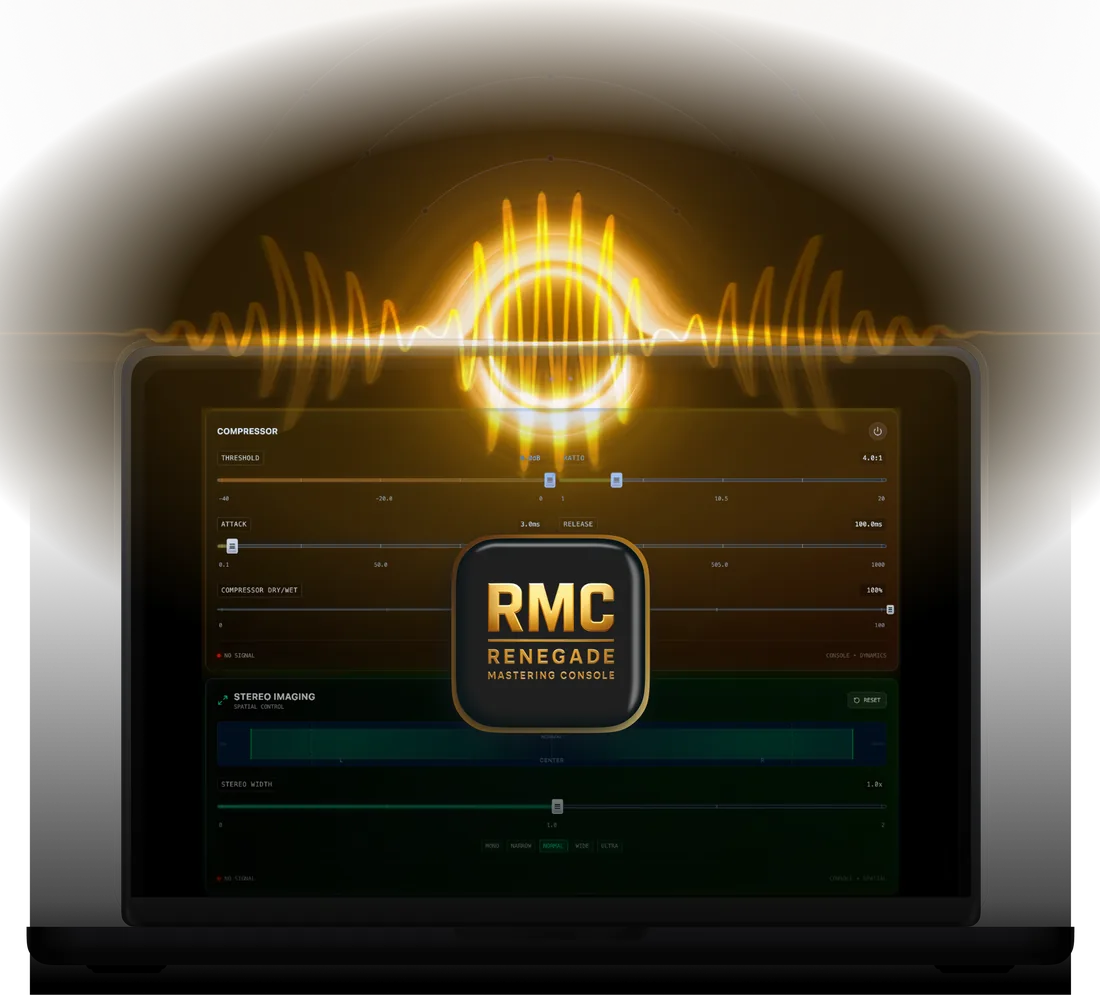 Mastering in the browserRenegade Mastering ConsoleA final-stage mastering enhancer that runs in your browser. Nothing to install.Free
Start here
Free plugins you keep. No trial clock and no card.
 Optimized by Seraphinite Accelerator