Engineers tend to reach for a vari-mu compressor when a mix is nearly done and just needs to hold together. Used well, you don’t hear compression. You hear the mix settle into place.
This guide covers how vari-mu compression works, how it differs from VCA and FET designs, how to set one up on a mix bus or master, and why pairing it with a VCA stage fixes its one real weakness.
What is vari-mu compression?
“Mu” is the amplification factor of a vacuum tube. In a variable-mu (vari-mu) design, the tube’s gain depends on the bias at its grid. The compressor turns the incoming signal into a control voltage and feeds it back as bias, so when the level rises, the tube’s gain falls.
The tube itself does the gain reduction. That’s the key difference from other designs, and it explains nearly everything about how a vari-mu compressor sounds.
How a vari-mu compressor behaves
Program-dependent response
A vari-mu stage reacts to sustained level more than to single transients. A dense chorus gets more gain reduction than a sparse verse, and the reduction follows the arrangement rather than every drum hit. You set it once and it responds to the song.
A soft knee with no corner
There’s no fixed ratio and no point where compression suddenly switches on. The curve is gentle at low levels and gets firmer as the signal pushes harder. So the transition from “not compressing” to “compressing” is inaudible.
Gain reduction that settles rather than grabs
A vari-mu stage doesn’t clamp down on the front of a note. The body of the program comes down smoothly, and much of the transient detail survives. That’s where the reputation for “glue” comes from: it pulls elements together without flattening them.
Harmonic coloration from the tube
The harder a tube works, the more it distorts. In a vari-mu compressor, coloration rises with gain reduction. At moderate settings this sounds like density and weight rather than obvious distortion. Pushed harder, it becomes audible character.
The trade-off: peaks escape
The same behavior that makes vari-mu smooth also means fast peaks can slip through. A snare crack or a sudden transient spike may pass untouched. On a mix bus that’s often what you want. On a master heading to a ceiling, it’s a problem you have to solve somewhere else.
Vari-mu vs VCA vs FET compression
- Vari-mu: reads level, has a soft program-dependent curve, and colors as it works. Best for mix bus glue, mastering, and making dense arrangements feel like one performance.
- VCA: clean, precise and repeatable, with defined threshold, ratio, attack and release, and it can be fast. Best for peak control, drum bus punch, and mastering jobs where you need predictable numbers.
- FET: very fast and assertive, with obvious character when pushed. Best on individual sources (vocals, drums, bass) where you want to hear the compression.
A useful rule of thumb: FET when you want to hear the compression, VCA when you need exact control, and vari-mu when you want cohesion you feel more than hear.
When to use a vari-mu compressor plugin
- Mix bus glue. A decibel or two of vari-mu compression makes separately recorded parts feel like they share a room.
- Mastering. Gentle, level-following reduction evens out a program without changing its shape.
- Dense, layered productions. Stacked guitars, big synth beds and full band arrangements benefit from compression that responds to the whole rather than to individual hits.
- Sections that need to breathe. Because the reduction follows the arrangement, choruses sit down slightly and verses open up, without automation.
It’s less suited to jobs that need hard, fast peak control on their own, or to single sources that should sound audibly squeezed. That’s VCA and FET territory.
How to set up vari-mu compression on a mix bus or master
These are starting points, not rules. Your material decides.
- Gain stage first. A vari-mu stage responds to level, so the level you feed it changes how hard it works. Leave sensible headroom on the bus before you start.
- Aim small. Around 1 to 2 dB of gain reduction on a mix bus, and often 0.5 to 1.5 dB on a master, is a good first target.
- Watch the meter move with the song. Gain reduction should rise and fall between sections. If it sits pinned at the same value, you’re working it too hard.
- Use slower release times for glue. If the mix pumps audibly with the kick, lengthen the release or bring in a sidechain high-pass.
- High-pass the sidechain. Starting somewhere around 80 to 150 Hz keeps low end from driving the compression, so the bass doesn’t pull the whole mix down on every note.
- Level-match before judging. Compression and tube harmonics both change perceived loudness. Compare at matched level, or louder will win every time.
- Listen to the delta. Soloing what the compressor removes tells you quickly whether it’s catching the body of the mix or chewing on transients.
Mix bus vs master
On a mix bus, put the compressor in early and mix into it, so your balance decisions account for what it does. On a master, be more conservative: the mix is already finished, and the job is to hold it together, not reshape it.
Why a two-stage vari-mu and VCA design helps
Vari-mu is excellent at leveling a program and weak at catching fast peaks. A VCA is the opposite. Put them in series and each stage does the job it’s good at, so neither has to be pushed until it sounds strained.
Order matters:
- Vari-mu, then VCA: the tube stage levels the program first, and the VCA catches whatever escapes. A natural choice on a master where peaks need to stay controlled.
- VCA, then vari-mu: the VCA takes peaks off before the tube stage sees them, so the vari-mu responds to the body of the mix rather than being yanked around by spikes. Useful on transient-heavy material.
Doing this with two separate plugins works, but you’re left guessing which stage is actually doing the work. That’s the problem a single two-stage design is built to solve.
RSL Bastion: a dual-stage vari-mu and VCA compressor
To be clear up front: RSL Bastion is our own plugin. Version 1.0.0 was released on 4 October 2026.
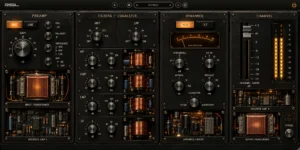
Bastion is a dual-stage mastering compressor: a vari-mu program compression stage and a discrete VCA peak compression stage in one chassis, in either order. Pick VARI-MU → VCA to level the program first and catch what escapes, or VCA → VARI-MU to take peaks off before the tube stage sees them. The panel follows the order you pick, and the meters show which stage is doing the work.
The vari-mu stage
It reads level rather than peaks, its curve has no corner, and it never audibly grabs: the reduction settles instead of clamping. COMPRESSION is drive, not a threshold. It pushes harder into a fixed cell and takes the same amount back out, so turning it up makes the stage work harder, not louder. That makes level-matched comparisons much easier.
The tubes distort more the harder the stage works, and HARMONICS (0 to 100) decides how much of that you keep. The valve stage runs at twice the sample rate so it colors instead of aliasing.
The VCA stage
Rectifier detection, with ratio, knee, attack and release on marked detents, so a setting you like can be written down and found again. There’s an optional AUTO release.
The rest of the panel
- Stage balance, plus crest in and crest out readouts
- Monitor the vari-mu, the VCA or the delta
- Threshold link
- Per-stage sidechain high-pass, stereo link and mix
- Headroom calibration, bass mono and a true-peak ceiling
- Latency of 46 samples (about 1 ms at 44.1 kHz), constant at every sample rate and reported to the host
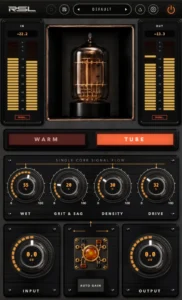
One note on scope: Bastion controls dynamics. It isn’t a color box. If you want harmonic density on purpose, put RSL Dual Core Saturator in front of it.
Pricing and availability
- $69 founders’ price until 30 November 2026, then $99
- Released 4 October 2026 (version 1.0.0)
- macOS 11 or newer: Audio Unit, VST3, AAX (Pro Tools) and Standalone
- Windows 10 or newer (64-bit): VST3 and Standalone
- Installed and activated through the free RSL Hub app, with no license key, on up to 4 computers per account
Bastion is built by Mevin Riviere, a 2x RIAA Gold producer and engineer who has spent more than 15 years making records.
Try compression on your own audio first, free
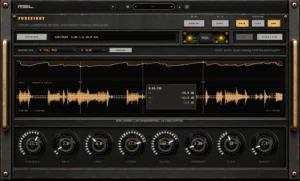
If you want to see what compression will do to your mix before you commit, RSL Foresight is free and needs no account. It captures up to 60 seconds of your audio, simulates a compressor and draws the gain reduction. SUGGEST sets a threshold for six sources and three goals.
FAQ
Is a vari-mu compressor good for mastering?
Yes, for leveling and cohesion. Its soft, program-dependent response evens out a master without reshaping it. Fast peaks can slip past a vari-mu stage, though, so on a master it’s usually paired with a faster peak compressor or limiter.
How much gain reduction should a vari-mu compressor do on a mix bus?
A good starting point is around 1 to 2 dB, with the meter moving between sections rather than sitting still. If you can clearly hear it working on the mix bus, try backing off before deciding it’s right.
Can I buy RSL Bastion now, and does it run on Windows?
Yes. It’s $69 at the founders’ price until 30 November 2026 (then $99), and it installs and activates through the free RSL Hub app on up to 4 computers, with no license key. It runs on macOS 11 or newer (Audio Unit, VST3, AAX and Standalone) and on Windows 10 or newer, 64-bit (VST3 and Standalone).