Digital audio spent thirty years getting cleaner. Converters improved, plugins stopped aliasing, and the noise floor dropped below anything a room could contribute. That work was worth doing. But somewhere in the pursuit of transparency, a lot of records started arriving technically perfect and emotionally flat: balanced, controlled, loud, and completely forgettable.
The gap is not level. It is not EQ. It is character: the sense that a signal passed through something that reacted to it. That is what saturation is for, and it is why an analog saturation plugin still earns a slot on a modern mix bus.
Clean became the default, and something left with it
Every piece of analog equipment in a classic signal path was, in engineering terms, broken. Transformers rang. Tubes compressed as they heated. Tape had a magnetic memory that made the next moment depend on the last one. Console channels drifted apart from each other because their components were never identical to begin with.
Engineers did not tolerate those flaws. They learned to play them. Pushing a preamp two decibels harder was a tonal decision, not a gain decision. The imperfection was the instrument.
Digital removed all of it by default. A gain stage in a DAW multiplies a number. Nothing rings, nothing sags, nothing remembers. You get exactly what you put in, which is precisely the problem when what you put in needs help.
A curve is not a circuit
Most saturation you encounter is a transfer curve. The plugin takes a sample, looks up where that value lands on a fixed curve, and outputs the result. Feed it −12 dBFS and you get the same answer every time, regardless of what came before it or what the signal is doing musically.
That is waveshaping. It generates harmonic distortion, and used well it is genuinely useful. But it is static. The processor has no state.
Real circuits do. This is the distinction that shapes everything we build at Renegade Sound Labs, and it is worth being precise about, because “analog-modeled” gets used to mean almost anything.
Memory
Magnetic tape exhibits hysteresis: its response depends on its recent magnetic history. A transient arriving after a loud passage does not meet the same medium as one arriving after silence. The tape has not finished settling. That path-dependence is a large part of why tape “glues”. It is not compression alone, it is a system that carries the last few milliseconds forward into the next.
Program dependence
Drive a tube stage harder and it does not simply distort more. It distorts differently. The harmonic balance shifts, the bias point moves, and the recovery changes. The device responds to what you feed it rather than applying a fixed transformation on top of it. Two mixes hitting the same circuit at the same level can come out with meaningfully different character because their content differs.
Instability
Component tolerance meant the left channel was never quite the right channel. Supply voltage sagged under load and recovered at its own pace. Those small inconsistencies read as width and movement, and a perfectly matched digital stage throws all of them away for free.
We model behavior, not faceplates
There are already excellent recreations of specific legendary hardware. That is a legitimate craft and we are not competing with it.
Our interest is what sits underneath the faceplate: saturation curves, magnetic behavior, voltage interaction, material response, hysteresis, nonlinearity, memory, instability. Model the behavior rather than the box, and you are no longer bound by what the original chassis could physically do. You can take a magnetic response further than the tape formulation allowed, or apply a valve’s bloom to a band that never would have hit that stage in a real chain.
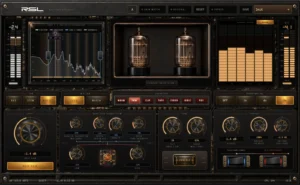
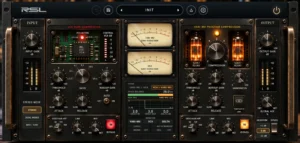
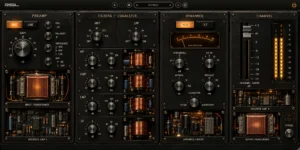
That is also how you end up with character models that never existed in a rack. Alongside the familiar territory of Warm, Tube, Clip and Tape, the Dual Core Saturator includes Ferro, Ionic and VO2, drawn from ferrofluid behavior, ionic systems and phase-transition materials. Not every idea needs a historical precedent. It needs to earn its place in a record. You can read more about how that philosophy came together on our about page.
Where saturation actually earns its keep
Understanding the theory is only useful if it changes what you do at the desk. Saturation in mixing tends to pay off in three distinct places, and the goal is different in each.
On individual tracks
Here saturation is a tone tool. A vocal that thins out above 4 kHz often needs harmonic content, not a shelf. Adding upper harmonics gives the ear something to latch onto without raising the fader. A bass that disappears on small speakers needs upper-order harmonics so the listener’s ear reconstructs a fundamental their laptop cannot reproduce. Drums that sound weak rather than quiet usually need transient shaping through a nonlinear stage rather than more compression.
The tell that you are reaching for the right tool: you keep wanting the track louder, but raising it unbalances the mix. That is a density problem, not a level problem.
On buses and stems
Mix bus saturation at the group level is about cohesion. Running a drum bus or a vocal stack through a single nonlinear stage makes the elements share a common distortion signature, and shared distortion reads as shared space. It is the plugin equivalent of tracking through the same console.
This is also where band-split processing starts to matter. A full-range drum bus driven hard gets its kick smeared long before the cymbals have taken on any color, because the low end holds most of the energy. Splitting the signal and driving each band independently is the difference between glue and mud.
On the master
Master-bus work is about density and perceived loudness, and the tolerances are tight. Harmonic distortion raises perceived loudness without raising peak level, which is why it has been part of mastering practice for decades. Overdo it and you flatten the dynamics you spent the whole mix building.
Two things become non-negotiable at this stage: true-peak control, so your master survives lossy encoding intact, and oversampling, so the harmonics you are deliberately generating do not fold back into the audible band as aliasing. Both are worth understanding before you commit.
Gain staging is still the whole game
The single most common mistake with saturation is treating the drive control as an amount knob. It is not. On a program-dependent processor, drive determines where on the circuit’s response you are operating. Change it and you change the character, not just the intensity.
Which means input level is a creative decision. Feed the same stage at −18 dBFS and −6 dBFS and you get two different processors. This is exactly the discipline analog engineers developed out of necessity, and it transfers directly.
Two practical consequences. First, set your input deliberately rather than letting whatever arrived from the previous plugin decide for you. Second, always compare at matched loudness. Saturation adds level, level sounds better, and an unmatched A/B will convince you that every setting is an improvement.
Hear what you actually did
Saturation is the easiest process to overapply, because it flatters immediately and fatigues slowly. What sounds exciting on the first pass often sounds harsh an hour later, and by then your ears have adapted and you cannot tell.
The defences are unglamorous and they work. Gain match every comparison. Monitor the residual, the difference between input and output, so you can hear the distortion you are adding in isolation rather than guessing at it underneath the music. Watch the harmonic content rather than trusting a drive percentage. And check on more than one system, because harmonic density behaves very differently on headphones than on a small speaker.
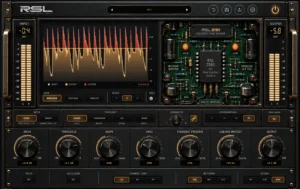
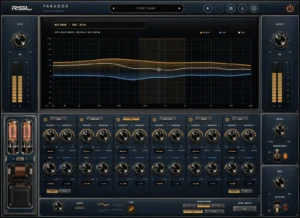
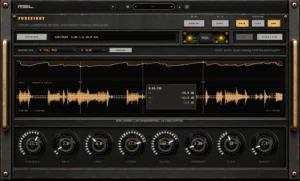
This is why our metering is built the way it is: spectrum, harmonic content, RTA harmonic injection, gain match and residual monitoring are there so the decision is informed rather than instinctive.
Where to start
If you want to hear program-dependent saturation without spending anything, RSL One is free and needs no license key. It runs the same Warm and Tube circuit as our flagship on a single core, with wet level, Depth, Density and Drive, plus Auto Gain so your comparisons stay honest by default.
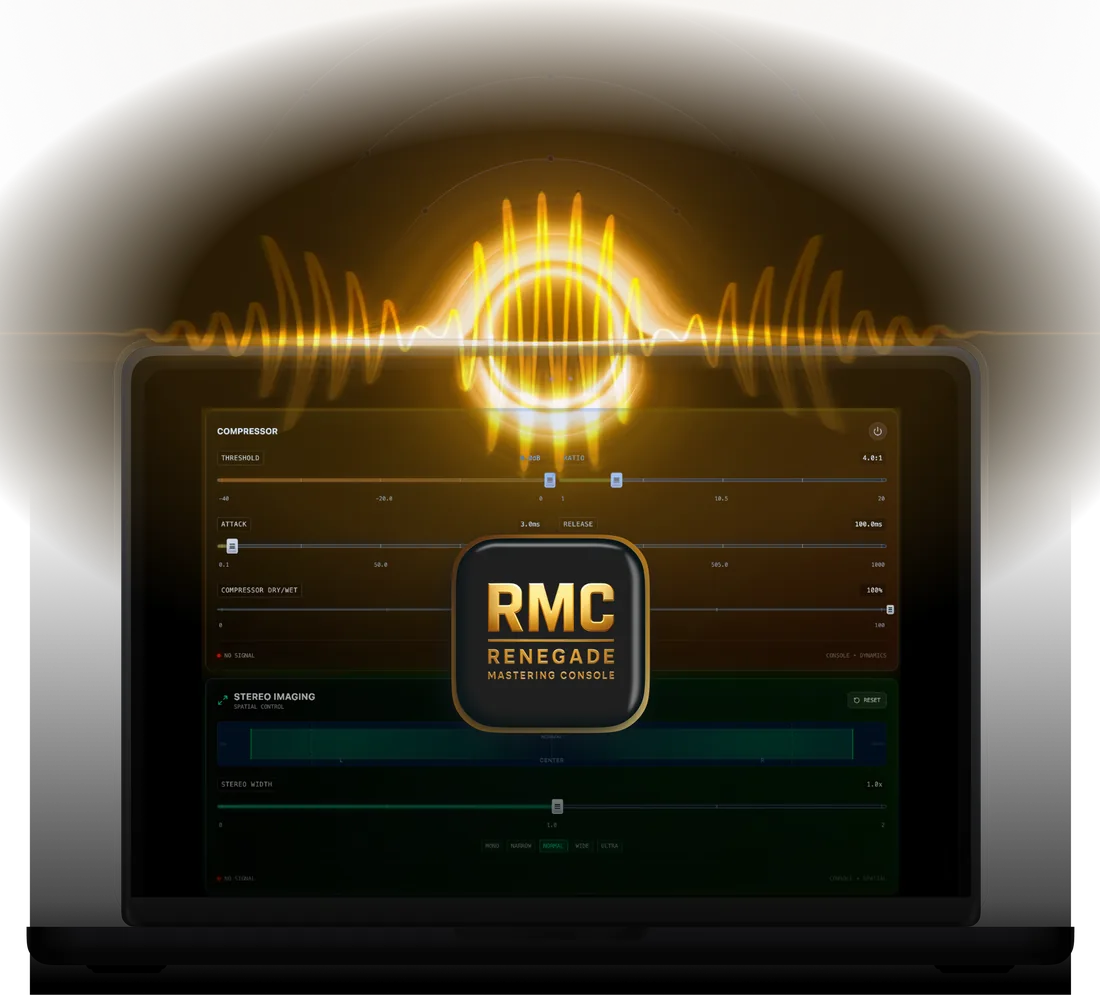
When you need the low end to stay composed while the top gets pushed (or the reverse), that is what the crossover and two independent cores in the Dual Core Saturator exist for. Both plugins run natively on Intel and Apple Silicon under macOS 11 or newer, in Audio Unit, VST3 and Standalone formats. You can see how they compare on the plugins page.
For the practical side of both, we have written a guide to using dual-core saturation on buses, stems and masters, and a walkthrough of getting started with RSL One.
Key takeaways
- Static transfer curves generate harmonics but have no state; real circuits carry memory, respond to program material, and drift. That difference is what “analog attitude” actually describes.
- Modeling behavior rather than a specific machine frees the processing from what the original hardware could physically survive.
- Saturation does three different jobs: tone on tracks, cohesion on buses, density on the master. Match the tool to the job.
- Drive is a character control, not an amount control. Input level changes which processor you are using.
- Gain match every comparison and monitor the residual, or you will overdo it and only notice tomorrow.